
Cornfields gave way to scrub, clay and sand as they got closer to New Mexico. I thought Kansas had been flat, but Oklahoma told us to hold its beer. In Kansas windbreaks, silos, barns and farmhouses occasionally interrupted the flatness. This continued to be true in Oklahoma, but things taller than their mid-size car were even fewer and farther between. There were not even cows. Another marked difference was that in Kansas most of the roadkill had been raccoons but now there were also armadillos.
“We’re not in Kansas anymore!” I announced as we drove by yet another flattened armadillo.
No one said anything except for Julian, who asked if we were there yet.
It was becoming increasingly difficult to keep Julian occupied and we had not yet resorted to handing him the phone.
That we needed to look at the map was the de facto rationale we gave him when he asked why.
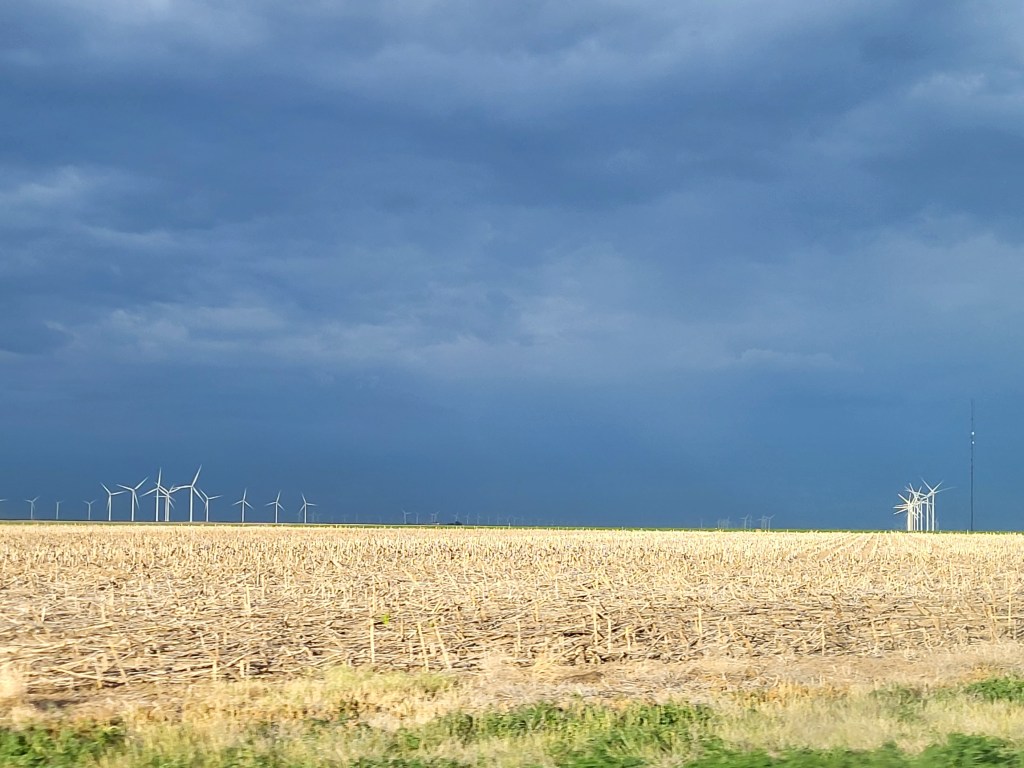
We had stayed strong all across Kansas. Julian’s crayons were still pointed, the pages of his notebook were still mostly blank and there had been enough grain silos, farms, cows, road signs, eighteen-wheelers, trees and even a miles-long windmill farm on the first day of driving on their way to spend the night in Garden City for I Spy to sustain us.
Today our last destination was Santa Fe. Earlier in the morning we played what I called the Alphabet Game, which merely involved going through the alphabet and naming things that begin with each letter. Julian found it more entertaining than I had imagined, but our last game ended in frustration when we couldn’t think of new X or Z words.
Next I taught him how to get truck drivers to honk at us. As far was I was concerned there was no Great American Family Road Trip if you did not spend at least a little time desperately pumping your fist in the air trying to get a driver’s attention for the simple but satisfying reward hearing the loud, bellow of an eighteen-wheeler’s horn.
I taught Julian the proper fist clench and arm pump while Jeremy drove. I was in the backseat with him and baby Benji, who had thus far been content to chew on teethers and watch the cars behind us. I soon learned that drivers these days were not as cooperative as they were three decades ago. As we drove by them I saw them not scanning the road, but staring down, presumably at the phone on their laps. They certainly didn’t see a grown woman and a four-year-old flapping their arms in unison for a honk as a pudgy baby observed with a bemused look on his face.
But now it was my turn to drive and on this stretch of route 56 going through Cimarron County, Oklahoma there were hardly any other vehicles or anything else on the road. Our next stop before hitting Santa Fe was Clayton, New Mexico, where there was a coffee shop Jeremy had found on Google maps. I had already asked Jeremy, who was navigating, how long it would take to get there, but I already forgot the answer. I was about to ask again, as it would be tantamount to me asking if we were there yet. If the weather had been nicer the next there could have been any place off the side of the road for a quick scamper, but it was 100 degrees here and almost everywhere else in the country, except for where we were ultimately heading, which was to see various members of our family strung along various municipalities on the Pacific Coast Highway like beads on a necklace. At this very moment it was 75 degrees at my aunt’s house near the beach in San Luis Obispo, California.
The question of if they were there yet had resumed at full throttle. But what was a road trip across the country if you didn’t ask your parents a hundred times a minute if you were there yet? It didn’t even matter where there was. The question was obligatory whether they were going to a rest stop, a grain silo or a gas station. Conversely, if you are a parent and you weren’t incessantly interrogated about where you were then did you really complete the benchmark known as the Great American Family Road Trip?Jeremy and I were keen on maintaining the authenticity of our Great American Family Road Trip and apparently we were willing to sacrifice our sanity for it.
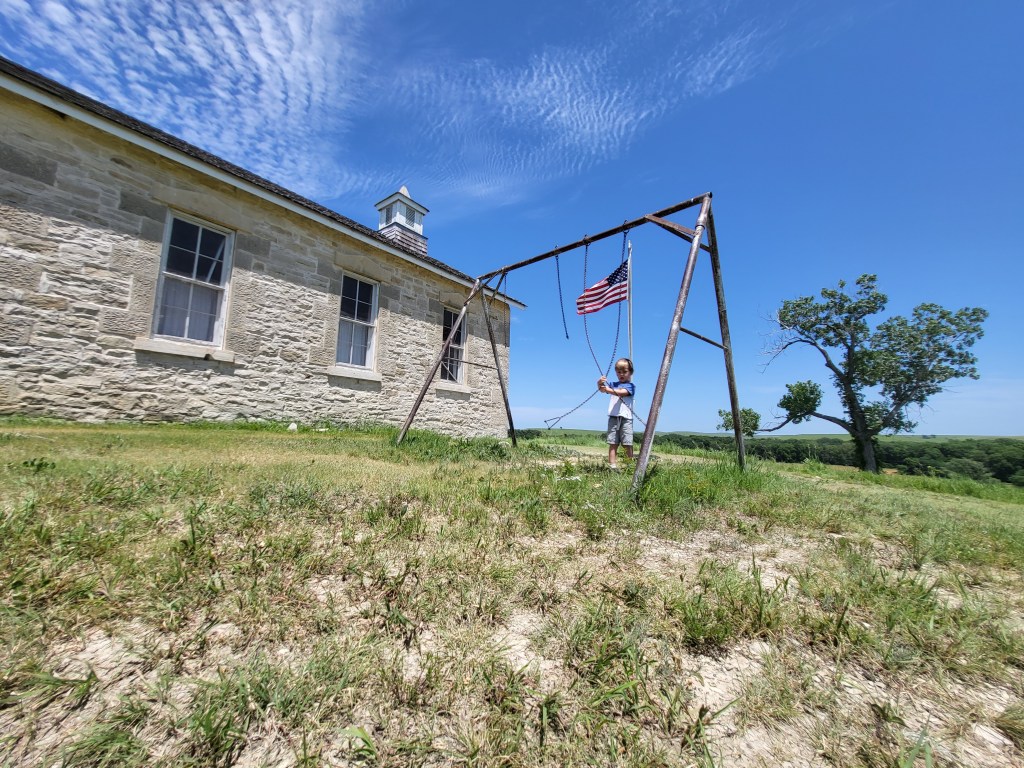
My own dad had several treatises on road-induced boredom. It’s good for you, he told me and my sisters. Only boring people get bored, he would add before imploring us to look out the window. It didn’t matter where we were—whether driving on Going to the Sun Road in Glacier National Park, past a feedlot in western Kansas or through a suburban landscape of strip malls and drive-throughs. We had been on the road for less than an hour, leaving my mom’s house in Kansas City two hours behind schedule en route to our first stop at the Tallgrass Prairie National Preserve near Strong City, Kansas when I found myself encouraging Julian to do the same.
When I looked out the window as a kid, especially when driving through Kansas on the way to the Rockies on our annual camping trips I would see myself galloping on horseback alongside the car. In reality I had been on a horse less than a handful of times, but that didn’t stop me from riding with the prowess of a Dothraki horseman as I glided over ravines and irrigation ditches in graceful arching leaps. As the farmlands of Kansas and eastern Colorado gave way to desert clouds of sand and dirt trailed us as we galloped past tumbleweeds and sage. When the flatness gave way to the Rockies I finally parked the horse in a mental stall for a well-deserved rest. Besides, the mountains didn’t need a mad dash on horseback to be captivating and they were and far too arduous for a horse to navigate anyway.
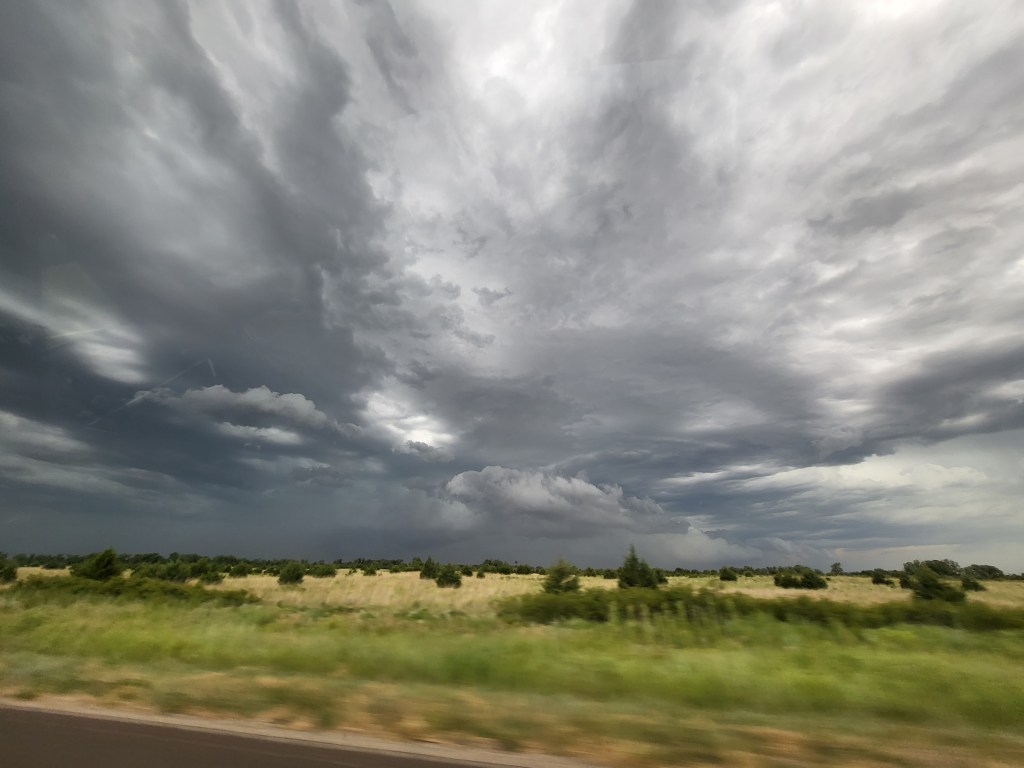
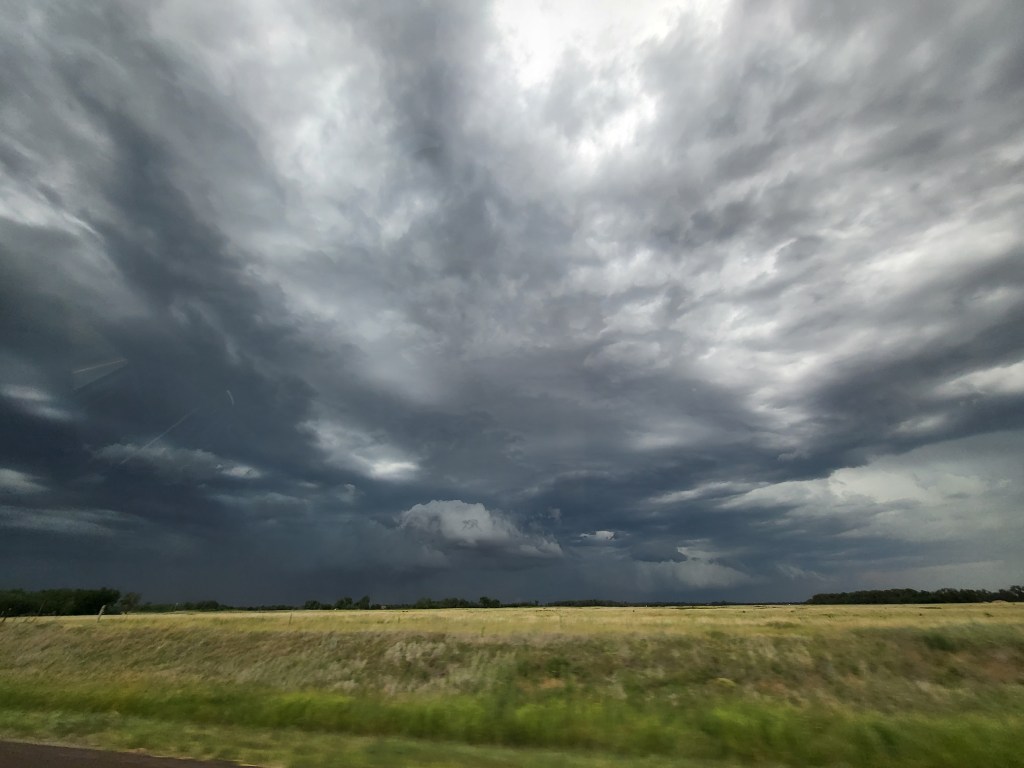
But Julian had never been on a horse and hadn’t expressed interest in horseback riding, which is a shame, because the plains were perfect terrain to gallop at full speed. The one thing that wasn’t flat were the clouds. Across the horizon clouds competed to see who among them could be Mount Everest. Cumulonimbi surged upwards and ended abruptly in plateaus that a kid flying past in an airplane might imagine bouncing on like a trampoline. I personally wanted to take a nap on one.
The skies over the eastern seaboard are tame compared to the moody and erratic nature of the skies over the plains. A sky could start the day with a cerulean cheerfulness, change its mind and don a gothic ensemble of dark grey clouds, accompanied by booming rumbles and flashing fury. And when the sky dresses in is absynthe green and flashes her mamatus you may even need to find a basement. That’s what people west of the Mississippi and east of the Rockies will tell you their grandparents told them.
I tried not to worry as the sky darkened around us. The weather apps warned of thunderstorms in the vicinity, and the flatness gave a generous view of a storm to the north, but when you are seeing in two dimensions it’s hard to tell how far away lighting is when it slashes the horizon. The lighting, while fierce, could have also been entertaining, but it was not visible from Julian’s side of the car.
It was when the sky became grey with the green undertones of someone who is about to barf that I started to scan the side of the highway for possible refuge should a tornado suddenly appear. I knew the danger was mostly in my head. There had been no tornado warning, which was good because there really was no cover. In the event of a tornado the abandoned barns on the side of the road would become death traps that could impale you with planks of wood and rusted nails flying at 300 miles per hour if it hadn’t already killed you by collapsing on top of you. Perhaps a cement grain silo would do, but how to get into one? Route 56 which followed the old Santa Fe railroad, which had been preceded by the Santa Fe trail. Every so often the tracks would go over an irrigation ditch, which might function as a crawlspace they could slide under.
“Are we there yet?”
The question derailed my morbid train of thought, but also gave me an idea.
I Spy and the alphabet game had reached their limits, and Julian’s crayons had tumbled under my seat. Jeremy could not grab them unless he crawled over Benji, who was mercifully asleep, but an idea for another game, something that could also be a teachable moment, had germinated.
“Let’s pretend a tornado is coming and we have to spy a good spot we could hide under before it gets us!”
Jeremy emitted sounds of protest from the back seat. I was aware of sounding like the kind of person who builds a bomb shelter in the basement but this is what scraping the bottom of the barrel looks like when you’re trying to entertain your kid as you drive across northwest Oklahoma. Besides, Jeremy is from Boston. He didn’t grow up with mandatory tornado drills in school, nor did he have to spend the night in the basement because of a tornado warning. I was five when the whole family fled to the basement after a tornado warning. It wasn’t the just the warning that ultimately caused us to flee, it was the gigantic slab of green lightning that stabbed our side yard as we looked out the window in the hallway not twenty feet away. We didn’t dare venture back upstairs. I had to void my bowels into an empty coffee tin by candlelight because the electricity was out and my parents would not me use the bathroom upstairs.
As my sisters and I got older every tornado season my dad would drive us to tiny towns further into tornado alley to survey the damage. He wanted us to see what nature was capable of, but also these excursions were relatively free. We saw houses and municipal buildings blasted to smithereens, as if the big bad wolf had come into town but only to settle a score a few houses, or just one block, before moving along and then maybe for good measure prying off the roof of a diner in his search for piggies, but leaving the rest of the building intact. Even if the tornado’s rampage was a week old and the sky was robin’s egg blue with nary a cloud I still felt it could be lurking around the corner, ready to attack at a moment’s notice.
The same feeling heckled me in Oklahoma.
Julian did not need to be convinced to play the tornado game. What’s more fun and exciting to a four-year-old than the thought of beating a natural disaster?
I ran through the basics. Everyone in the Midwest knows the best place is a basement, and if you can’t find a basement, go somewhere away from windows, and if you’re in a car the best place is under an overpass or in a tunnel and if you can’t find an overpass or a tunnel get into a ditch and if you can’t find a ditch you’re shit out of luck.
“Basically you wanna find somewhere that will protect you from above–with a really strong ceiling, not like that,” I said, pointing to an old barn on Julian’s side of the car. “A tornado might rip that apart while you’re in it.”
“The more underground the better,” I added. “With only tiny windows, or no windows at all. The less glass the better.”
“Julian you will probably never need this information,” interjected Jeremy.
I heard silence from the back seat, which I took to mean that he was scanning for a good hiding place or trying to figure out the meaning of all the words I had just said.
“But he’s being so quiet,” I whispered back.
“What about that?” he asked as we passed by a grain silo.
“That could be perfect, but how would we get in?”
More silence.
“Mommy, I don’t see anything else.”
“There’s at least one thing,” I said, eying the train tracks.
“Under the car?”
“Not bad! But tornados can carry away cars, and then what would we do?”
“Then we would fly!”
I laughed, and reminded myself that I still needed to have Julian sit down and finally watch the Wizard of Oz.
“The best place, from what I can tell, is right under those tracks. See the tiny little bridge over the ditch?”
There ensued a debate on whether or not the wood from the ties would turn into daggers in the event of a tornado, but it was generally agreed that the iron that held the tracks in place would cling to the earth more firmly than the wheels of a car, and the giant rail spikes would hold the ties in place better than your average nail to an average plank of wood in and old barn.
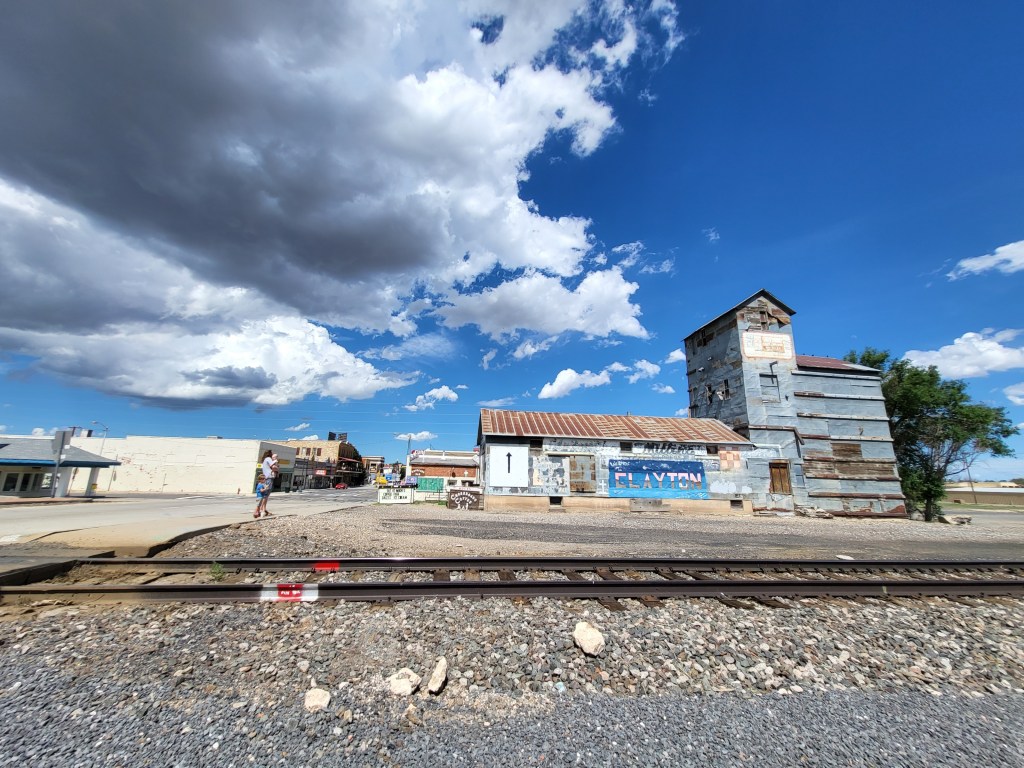
And then, for the first time in many miles a sign appeared on the horizon. I did not want to ask Jeremy to consult his phone to see how far we were from Clayton. It would ruin the only non-anxiety inducing excitement we had all day. Instead I waited for the words in the green rectangle, the only thing taller than our car for miles, to become legible.
Julian was quiet too, wanting to figure out if he could read the number on the sign. We both waited for the sign to get bigger and bigger until we bore down on it.
“Only twenty-two miles!” exclaimed Julian before the sign receded into the rearview.
“We’re almost there!”
 Please Don't Lick the Taxi
Leave a comment